

We are seeing a quiet but strong form of colonization in the age of artificial intelligence. There are no armies or ships involved. It spreads through servers, algorithms, and data centers. It talks about open-source, innovation, and efficiency, but behind this smooth talk is a real threat: AI colonialism. And one of the worst things that could happen is that machines are rewriting our history.
People all over the world are using AI chatbots and search engines to help them answer hard questions, like those about history, identity, and being a citizen. What do you do when the answers these tools give you are biased, missing information, or just plain wrong? What if the AI is secretly programmed or passively trained to favor the views of powerful countries and downplay or distort the experiences of countries that used to be colonies? That would be even worse.
This isn't a story from science fiction. It's already happening. And if we don't do anything, technologies that we don't control or fully understand will change the stories that make us who we are, and maybe even erase them.
Image created using OpenAI’s DALL·E on ChatGPT (2025). Source: https://openai.com/chatgpt
The New Digital Empire: What is colonialism in AI?
AI colonialism is a new trend in which powerful countries and companies take data, labor, and cultural value from the rest of the world, especially the Global South, to make money off of AI systems. Most of the time, these systems are trained on data from the internet that mostly shows Western voices, values, and points of view. The outcome? An AI system that "thinks" in English, focuses on Western history, and has deep-seated biases against societies that aren't Western. It follows the same patterns as colonialism: taking resources, benefiting one side, and controlling culture. But now, the "resource" is data, the "territory" is digital infrastructure, and the "weapon" is controlling the story.
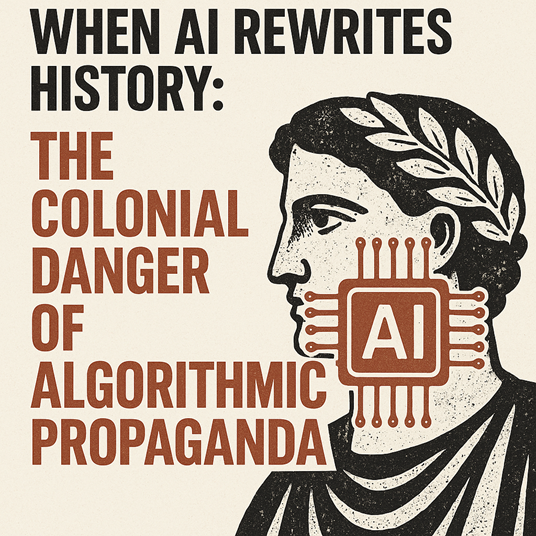
Image created using OpenAI’s DALL·E on ChatGPT (2025). Source: https://openai.com/chatgpt
When AI Changes the Past
AI doesn't just keep track of facts. It explains, sums up, and shows them as the truth. When someone asks an AI, "What happened in [insert historical conflict]?" The answer could be a neat paragraph, but that paragraph could be affected by political agendas, biased datasets, or sources that are in the dominant language.
This has already happened before. Some generative AI models have described colonization as a “mutual exchange of culture,” ignored war crimes committed by imperial powers, or used dismissive terms to describe national independence movements. People who fought against the government have been called "militants," summaries of massacres have left out victims, and big historical wrongs have been downplayed or denied.
Even worse, these AI-generated stories are told with certainty—no footnotes, no debate, and no room for interpretation, only answers. This makes it look like it's objective, but it's often just algorithmic propaganda. And this distortion grows quickly when AI is used in schools, the media, or even diplomacy. A biased model response can reach millions of people in seconds, changing the way people, especially those who will never read a history book, see the world.

Image created using OpenAI’s DALL·E on ChatGPT (2025). Source: https://openai.com/chatgpt
The Algorithmic War for the Future
AI isn't just changing the past; it's also changing the future. Bots that work for politicians spread false information on social media. Deepfakes pretend to be leaders. Generative tools trained on biased or distorted content make fake articles and headlines.
This is especially bad for smaller or poorer countries. They have to use foreign platforms for everything, including education, communication, government, and even national memory, because they don't have strong local AI. They are outsourcing not only their technology but also their truth.
It's not just about getting the facts right; it's also about cultural identity. When AI can't say the names of your leaders, doesn't know your history, and thinks your language is gibberish, it's not a bug. It's a sign that you don't matter to the machine.
Why Each Country Needs Its Own AI
Countries need to take bold steps to get back their digital sovereignty in order to stop this. That starts with making national AI systems—tools that can understand and respect local languages and cultures, and that keep historical truth.
Having a national AI doesn’t mean reinventing the wheel. It means putting money into local datasets, backing research in local languages, making training sets that include indigenous knowledge and national heritage, and managing the computer infrastructure that makes all of this possible.
Think of an AI from Thailand that knows a lot about the country's history and languages. Or an AI from South Africa that speaks Zulu, Xhosa, Afrikaans, and English and can keep oral history alive and fight against the erasure of the apartheid era. Or an Indonesian AI that doesn't call its anti-colonial struggles "rebellions" in a footnote.
These models wouldn't just be tools; they'd also protect memories, teach the truth, and stand up for the dignity of the nation.
The Price of Being Dependent
Some people might say that building national AI is too expensive, takes too long, or isn't needed. But what else can you do?
• If you depend on foreign AI, you have to accept their priorities.
• It means putting your faith in systems that you can't check, change, or question.
• It means seeing other people tell your story or not tell it.
• It means that future generations will learn a version of history that doesn't include them.
Without national AI, countries could become digitally dependent in more ways than just financially. They could also become dependent on culture and ideas.
Let's be clear: AI is no longer just a problem with technology. It's important for national security, information sovereignty, and the survival of culture.
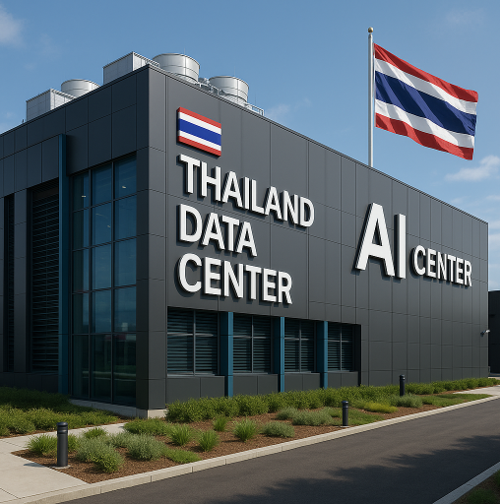
Image created using OpenAI’s DALL·E on ChatGPT (2025). Source: https://openai.com/chatgpt
Creating a Future for Ourselves
Yes, there are problems, like a lack of infrastructure, a brain drain, language digitization, and a corporate monopoly. There are also answers, though:
• Working together in the region: ASEAN, the African Union, and others can all invest in the same AI frameworks.
• Partnerships between the public and private sectors: Universities, startups, and governments need to work together to create models that include everyone.
• Open-source ecosystems: Countries can work together to make free and fair alternatives to business models.
• Data protection laws: Make sure that foreign companies can't easily get to national data.
But more than anything else, countries need to believe that their languages, stories, and history are worth protecting, not just from being erased but also from being changed.
Conclusion: The Truth Is Power
In conclusion, AI is becoming the main storyteller. If we let algorithms from other countries do the talking for us, they will change how the world sees us and how we see ourselves.
AI doesn't just change the past when it rewrites history. It takes over the future.
Every country needs to take charge of its digital future to stop this. That means making AI systems based on truth, memory, and justice—systems that don't help the powerful but give power to the forgotten.
Because being able to tell your own story is what freedom is all about. We can never give that up, not to a colonizer, and certainly not to a chatbot.
Din Suphawat
Central Northeastern Provincial Cluster Office
Digital Economy Promotion Agency
Reference:


